


The Best Paint for Melamine Cabinets – Thinking about painting your melamine cabinets? The secret isn’t just one can of paint. It’s all about using the right system. Real success comes from a simple three-part process: a deep clean, a light sanding, and the right high-adhesion primer to make your new finish last.
Understanding the Right Paint System for Melamine
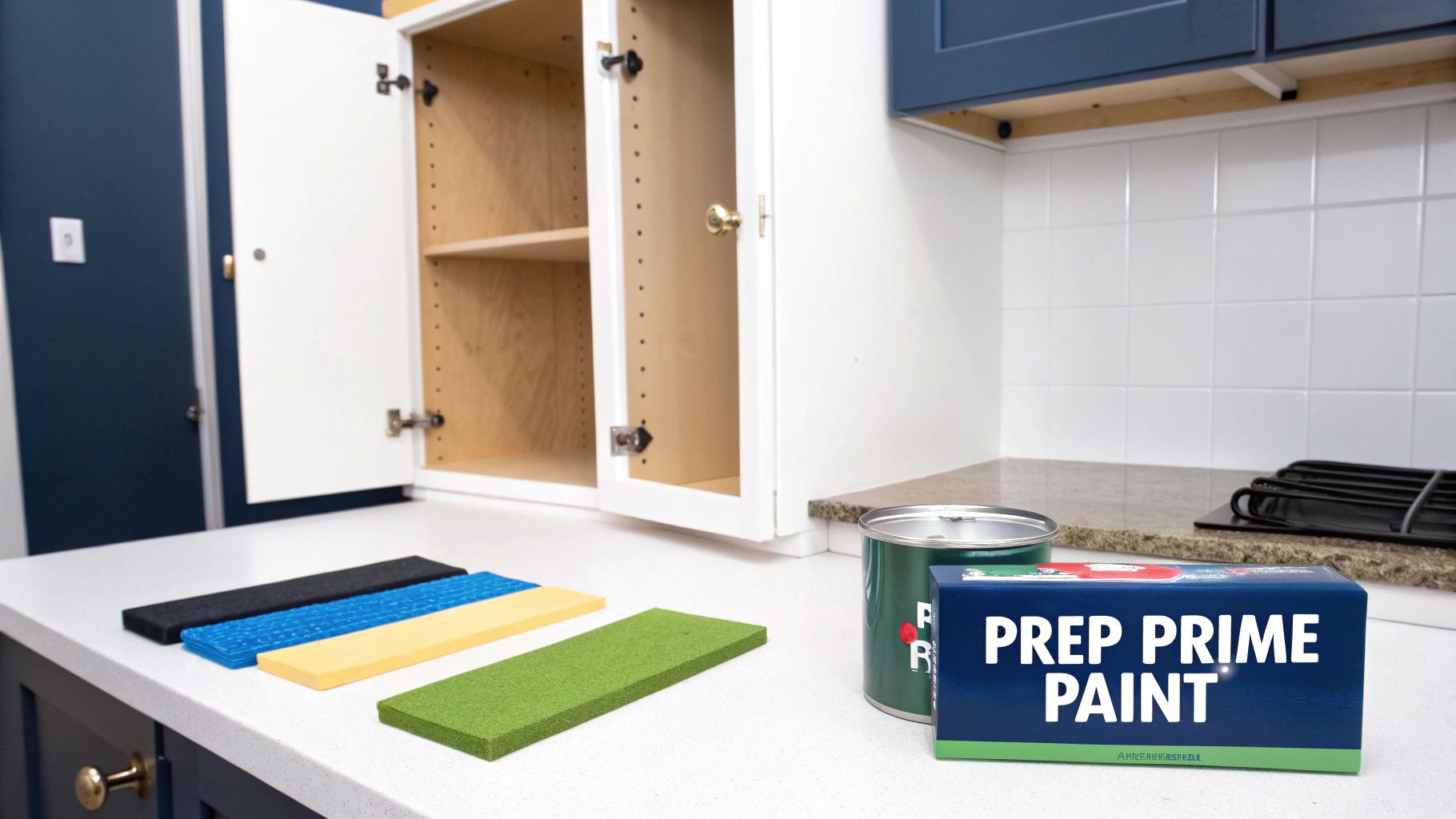
Painting melamine is a popular project for homeowners across Toronto, from condos in North York to family homes in Scarborough. But it’s also one of the easiest projects to get wrong.
That super-smooth, plastic-like surface on melamine is designed to resist almost everything—including paint. If you don’t use the right approach, you will see chipping and peeling very quickly. This guide is your simple map to getting a beautiful, lasting finish you’ll be proud of.
The Key to Success: Primer and Paint Working Together
You can’t get a durable finish on melamine with just one product. It’s about a team of products working together. Think of it like building a house—you need a solid foundation before you put up the walls.
Here’s what every successful paint job needs:
- A High-Adhesion Bonding Primer: This is the most important step. A special bonding primer is made to grab onto slick surfaces like melamine. It creates the perfect anchor for your topcoat.
- A Durable Topcoat: This is your coloured paint. It gives you the final look and protects the cabinets every day. For a DIY project, high-quality acrylic cabinet paints are a great choice.
- Professional-Grade Coatings: As professional painters serving the GTA, we use advanced products like Renner Italian cabinet coatings. These give you a true factory-grade finish with amazing durability. It’s why we confidently offer a 5-year warranty on our cabinet work.
The secret to a long-lasting melamine paint job is 90% preparation and 10% application. Rushing the cleaning, sanding, or priming steps is the number one reason DIY projects fail.
Painting your cabinets can be a big part of a larger renovation. If you are planning a bigger project, learning about planning your kitchen remodel can give you some great ideas for a smooth makeover.
At Royal Home Painters, our award-winning team has helped hundreds of clients in Vaughan, Richmond Hill, and Markham get beautiful cabinet transformations. If you’re not sure about doing it yourself, we are here to help. Just send us photos for a quick quote.
Why Is Melamine So Tricky To Paint?
Have you ever tried to paint something very slick, like glass or plastic? The paint just beads up and slides off. That’s the same problem you have with melamine cabinets.
Melamine is not wood. It is a type of plastic laminate fused onto a particleboard or MDF core. This creates an incredibly smooth, non-porous surface. In simple terms, there are no tiny holes for the paint to grab onto. This is why standard paint, applied without the right prep, will almost always peel and chip in just a few months.
This lack of “tooth” is intentional. Melamine is made to be durable, stain-resistant, and easy to clean—great qualities for a cabinet, but a nightmare for painting.
The Science: Why Paint Won’t Stick to Melamine
When paint fails on melamine, it’s not because the paint is bad. It’s a problem of adhesion failure. For paint to last, it needs to form a strong bond with the surface underneath.
- Mechanical Bond: This happens when paint seeps into the tiny pores of a surface like wood or drywall, locking itself in. Melamine has almost no pores, so this can’t happen.
- Chemical Bond: This is where special primers work their magic. A high-adhesion bonding primer is chemically made to “bite” into a slick surface. It creates a new layer that your topcoat can stick to for good.
Think of it this way: painting melamine without a bonding primer is like trying to climb a wall of ice with no gear. A bonding primer is your ice axe—it creates the anchor points you need to hold on. This is why our professional cabinet refinishing process focuses so much on preparation.
Why Surface Prep is a Must-Do Step
Because melamine is so slick, any dirt left on the surface—grease, oils from hands, or old cleaning spray—will block the primer from sticking. This is especially true in kitchens, where grease from cooking settles on every surface.
Our detailed prep process, which includes degreasing and light sanding, solves these problems. It removes all the dirt and creates a micro-texture on the surface, giving the primer the best chance to form a strong bond. This careful approach is standard for all our projects across Toronto and the GTA, from Etobicoke to Markham.
The demand for durable cabinet solutions is growing. The cabinet manufacturing industry has seen steady growth, driven by homeowners wanting quality finishes that last. This shows why special painting techniques are needed for tricky surfaces like melamine. You can find more insights about the cabinet industry’s growth and trends on socaservicespainting.com.
If all this prep work sounds like a headache, don’t worry. Our award-winning team at Royal Home Painters has this process down to a science. We are a top-rated, fully insured company and provide free in-person estimates.
Essential Prep Work for a Perfect Melamine Finish
If there’s one secret I can share from my years of cabinet refinishing, it’s this: proper preparation is 90% of the job. This is the most important stage. It separates a professional, long-lasting finish from a DIY job that peels and chips within months.
Think of it as building the foundation for your new kitchen. If you rush this part, everything you put on top will fail. We’ll break down the process into simple steps. Each one is essential if you want your paint to stick.
This diagram shows what happens when you paint directly onto unprepared melamine.
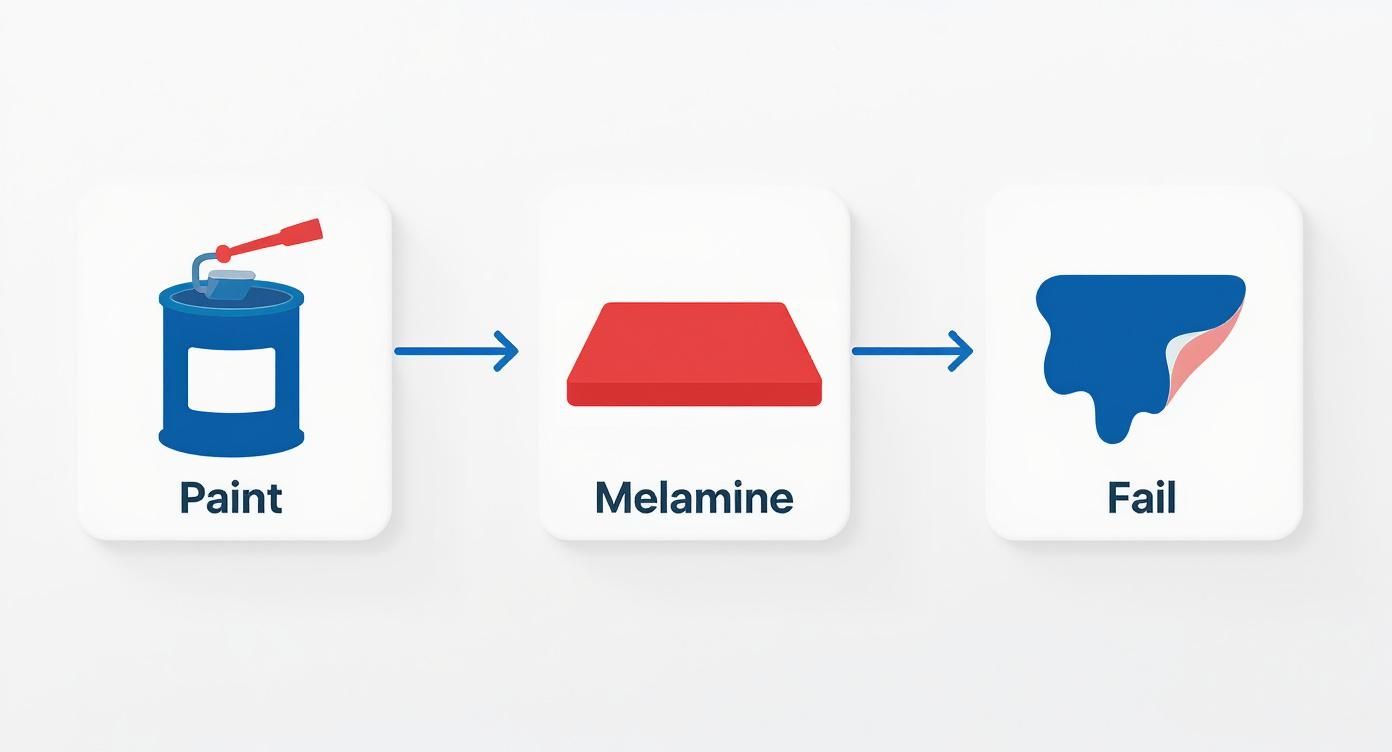
As you can see, the paint has nothing to grab onto, leading to complete failure. That’s why the prep work we’re about to cover is so important.
Step 1: Deep Clean and Degrease Your Cabinets
Kitchen cabinets, especially in busy homes across Toronto and the GTA, are covered in invisible grime. Cooking oils, grease, and fingerprints build up over time. This grime creates a barrier that blocks even the best primers.
You have to get every part of the surface you plan to paint perfectly clean.
- Use a powerful degreaser: A TSP substitute (Trisodium Phosphate) is great for this. It’s a heavy-duty cleaner that cuts through tough kitchen grease.
- Scrub everything: Use a non-abrasive scrub pad on the cabinet doors (front and back), drawer fronts, and cabinet frames.
- Rinse and dry completely: After scrubbing, wipe all surfaces with a clean, damp cloth to remove any leftover cleaner. Then, let the cabinets dry completely before moving on.
Step 2: Create a Surface for Paint to Grip
Once your cabinets are clean, the next job is to remove the factory shine. Melamine is so smooth that paint has nothing to hold onto. We need to create a “mechanical tooth” for the primer to bite into.
This is done by scuff-sanding. You are not trying to remove the melamine layer. You are just lightly scratching the surface to create tiny grooves for the primer to lock into.
For this step, follow this process:
- Choose the right sandpaper: Use a 180 to 220-grit sandpaper. Anything rougher can leave deep scratches that will show through your paint.
- Sand lightly but completely: Gently sand every surface that will be painted. The goal is to make the shiny finish look dull. The surface should feel slightly rough, not glossy.
- Wipe away the dust: After sanding, a fine layer of dust is left behind. This dust is just as bad as grease for paint. Use a tack cloth or a damp microfibre cloth to wipe away every particle.
This prep work is the most labour-intensive part of the project, but it is extremely important. For a deeper look at the whole process, check out our guide on how to refinish kitchen cabinets.
If this sounds like too much work, remember that our professional interior painting team handles every detail for you. As an award-winning, fully insured Toronto painting company, we know that great prep is the key to a flawless finish backed by our 5-year cabinet warranty.
Feeling overwhelmed? Send us a few photos of your kitchen, and we can provide a quick and easy quote for our professional cabinet refinishing services.
Choosing the Right Primer and Paint for Melamine
With your cabinets perfectly cleaned and sanded, you’ve built a solid foundation. Now it’s time to choose the primer and paint. This choice is just as important as the prep work.
Think of primer as a translator. Melamine and paint speak different languages. A high-adhesion bonding primer is the interpreter that allows them to connect, creating a bond that lasts.
This is not the same primer you use on drywall. You need a special product made to grab onto slick, non-porous surfaces.
The Best Primers for Melamine Cabinets
For a tough surface like melamine, you need a primer with serious gripping power. Homeowners in Toronto and the GTA have a few great options.
- Shellac-Based Primers: These are a classic choice for difficult surfaces. They offer incredible adhesion and are great at blocking stains. The downside? They have a very strong smell and need harsh chemicals for cleanup.
- Urethane-Based Primers: Modern urethane-based bonding primers are a game-changer. They provide adhesion as good as shellac but are water-based. This means less odour and simple soap-and-water cleanup, making them a better choice for interior projects in condos and family homes.
At Royal Home Painters, we almost always use high-performance urethane bonding primers for our cabinet refinishing projects across Vaughan, Markham, and the rest of the GTA. They provide the excellent bond we need to offer our 5-year cabinet warranty.
DIY Paint vs. Professional Coatings
Once the primer is on, it’s time for the colour coat. This is where you’ll see the biggest difference between a good DIY job and a professional cabinet refinishing service.
A dedicated DIYer can get a great result using a premium acrylic cabinet paint. These modern paints are designed to level out smoothly and cure to a hard finish. They are a big step up from standard wall paint. To learn more about different paint types, explore our guide on the 5 best interior paints for your home.
However, for the best durability and a true factory-like look, nothing compares to professional-grade coatings.
We use a special system with Renner™ Italian 2K (two-component) polyurethane coatings. This isn’t just paint. It’s a catalyzed finish where a hardener is mixed in right before we spray. This chemical reaction creates a surface that is extremely resistant to chipping, chemicals, and daily use.
Here’s a simple comparison to help you understand.
DIY vs. Professional Cabinet Coatings
| Feature | High-Quality Acrylic Cabinet Paint (DIY) | 2K Polyurethane Coatings (Professional) |
|---|---|---|
| Durability | Good. Resists scuffs and scratches. | Exceptional. Highly resistant to chipping, chemicals, and moisture. |
| Finish Quality | Smooth, but brush or roller marks are possible. | Flawless, factory-like smooth finish. |
| Application | Brush, roller, or DIY sprayer. | Needs professional spray equipment and expertise. |
| Cure Time | Can take up to 30 days to fully harden. | Cures quickly through a chemical reaction. |
| Cost | Lower upfront material cost. | Higher cost due to materials and professional labour. |
The choice depends on your goals. A good acrylic paint can give your kitchen a fantastic new look. But for homeowners looking for the most durable, long-lasting, and flawless finish, a professional 2K system is the best choice.
The global melamine market was valued at around $9.8 billion in 2024 and is expected to grow. This is driven by the demand for long-lasting coatings in furniture and cabinets, showing that homeowners are investing in quality. When picking a cabinet colour, you might also find inspiration from guides on choosing the [best paint colors for laundry cabinets](https://templetonbuilt.com.au/the-best-paint-colors-for- laundry-cabinets/) to create a unified look.
Our team is always happy to explain the options and provide a free, no-obligation estimate for our cabinet refinishing services.
Application Methods: How to Get a Smooth Finish
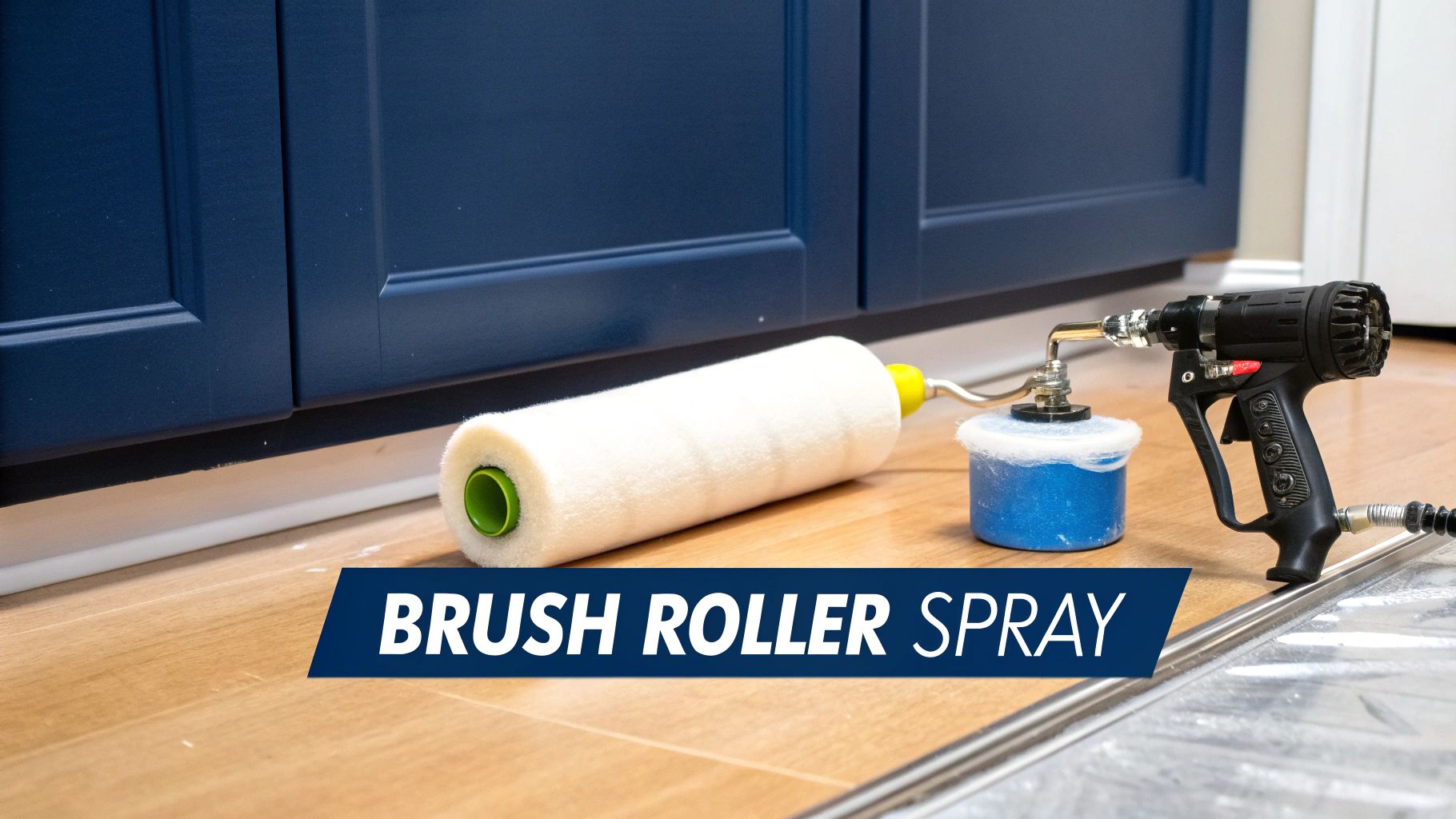
How you apply the paint to your melamine cabinets is just as important as the products you choose. Even with the best primer and paint, a poor application can leave you with a finish that looks unprofessional. The tool you pick—brush, roller, or sprayer—will determine the final texture and smoothness.
There are two main ways to paint cabinets: the traditional brush-and-roller method, or using a professional paint sprayer. While both can work, only one gives that truly flawless, factory-fresh finish.
Brush and Roller for DIY Cabinet Painting Projects
For most homeowners in Toronto tackling a weekend project, a good brush and roller are the best tools. This method is easy to start and doesn’t require expensive equipment. But getting a perfectly smooth finish this way takes a lot of patience and skill.
To get the best results with a brush and roller:
- Invest in a Quality Brush: Use a high-quality synthetic-bristle brush (a nylon/polyester blend is perfect). A cheap brush will leave ugly brush strokes.
- Use a Foam Roller: On flat cabinet doors, a high-density foam roller is your best friend. It leaves much less texture than a fuzzy roller.
- Apply Thin, Even Coats: Don’t put the paint on too thick. You will get a much smoother and stronger finish by applying several thin coats.
- Sand Lightly Between Coats: After a coat of primer or paint is completely dry, give it a quick, gentle sanding with 220-grit sandpaper. This smooths out any small bumps or dust.
Even with perfect technique, a brush and roller will always leave some texture. It’s almost impossible to match the ultra-smooth surface of a professionally sprayed cabinet with these tools.
Professional Spray Application for a Flawless Finish
For homeowners in the GTA who want perfection, there is no substitute for a professional spray application. This is the best method for cabinet refinishing. It’s what our award-winning team uses for every project, from North York to Etobicoke.
When we spray paint cabinets, the paint is atomized into a very fine mist. This mist settles evenly on the surface, creating a seamless coating with no brush marks or roller texture. We do this work in a controlled, off-site spray booth to ensure a dust-free environment and a perfect finish.
This method not only looks better, but it also creates a harder, more durable surface. For those who want to learn more, we have a detailed guide on spray painting kitchen cabinets.
For a perfect and durable result backed by our 5-year warranty, our professional spray refinishing service is the best choice. We provide free, detailed estimates for our interior painting and cabinet services throughout Toronto and York Region.
When to Hire a Professional Cabinet Painter
Doing a DIY project can feel great. But with melamine cabinets, hiring a professional is often the smartest choice for your home. It guarantees a perfect, long-lasting result that protects your home’s value.
The detailed, multi-day process of cleaning, sanding, priming, and painting can be overwhelming. Choosing a pro is a practical decision to save time, stress, and the risk of a costly mistake.
Key Reasons to Call an Expert Painter
For most homeowners we talk to across Toronto and the GTA, the decision to hire us comes down to a few key reasons. If you agree with any of these, it might be time to call a team.
- You Lack Time for Detailed Prep: Proper prep is essential for melamine, but it’s also very time-consuming. Professionals have this process perfected and never skip a step.
- You Don’t Have a Dedicated Spray Space: A flawless, factory-like finish is only possible by spray-painting in a controlled, dust-free space. Most homes don’t have this.
- You Want Superior Durability: We use professional-grade coatings you can’t buy at a hardware store, like Renner™ Italian 2K polyurethanes. These finishes are chemically hardened to resist daily use.
- You Value a Professional Warranty: Peace of mind is important. Our cabinet refinishing services are backed by a full 5-year warranty, so your investment is protected. Our company is also fully insured and covered by WSIB.
Choosing a professional isn’t giving up—it’s choosing certainty. You’re choosing a guaranteed result, premium materials, and a finish that adds lasting value to your kitchen.
The Royal Home Painters Advantage
As an award-winning, top-rated Toronto painting company, we offer more than just a paint job. We provide a complete, stress-free cabinet refinishing experience for our clients in Vaughan, Richmond Hill, and beyond. We have transformed hundreds of kitchens for satisfied clients across the GTA.
Our team of expert painters is dedicated to quality, customer service, and detailed workmanship. We handle everything, ensuring a perfect finish every time.
Ready for a flawless, long-lasting transformation without lifting a finger? Book your free, no-obligation estimate today. We make it easy—you can even send us a few photos of your kitchen for a quick and accurate quote.
Your Questions About Painting Melamine Answered
It’s normal to have questions. Painting melamine isn’t like painting a wall, and you want to get it right. Here are the simple answers to the questions our team gets asked most by homeowners around Toronto.
Can I Paint Melamine Cabinets Without Sanding?
Technically, you can, but you really shouldn’t. Some primers claim you can skip sanding on glossy surfaces. In our experience, skipping the scuff-sanding step is the number one reason DIY melamine paint jobs fail.
Sanding with 180-220 grit sandpaper creates a microscopic texture, or “tooth.” This gives the primer something to physically grab onto, creating a much stronger bond. If you want a finish that lasts, sanding is a non-negotiable step.
How Long Does Painted Melamine Last?
The life of your painted melamine finish depends on three things: the quality of your prep, the products you use, and daily use.
- A DIY Project: With good prep and high-quality acrylic cabinet paint, you can expect it to last 5-7 years before you see wear around knobs and handles.
- A Professional Job: When we use professional-grade coatings like Renner™ 2K polyurethanes, the finish can easily last 10+ years. These coatings harden chemically for incredible durability, which is why we back our work with a 5-year warranty.
The secret to longevity is patience. Many acrylic paints need up to 30 days to fully cure. Be gentle with them during that first month to avoid dings.
Is It Cheaper to Paint or Replace Melamine Cabinets?
Painting is almost always much cheaper than replacing. Replacing cabinets in the Toronto area can cost tens of thousands of dollars for demolition, new materials, and installation.
Professional cabinet refinishing, on the other hand, costs only a fraction of that. You get a beautiful new look without the huge expense and mess of a full renovation. For a quick idea of the cost, send us photos of your kitchen, and we can give you a fast, no-obligation quote.
Can You Paint the Inside of Melamine Cabinets?
Yes, you can! The steps are the same as for the outside: clean, scuff-sand, prime, and paint. Painting the insides creates a high-end, finished look, which is great for cabinets with glass doors.
Just remember that it adds significant time and material costs to the project. If you’re considering it, talk to your painting expert about the pros and cons for your budget.
Ready to give your kitchen the flawless, durable finish it deserves? The award-winning team at Royal Home Painters has helped hundreds of homeowners across Toronto, Vaughan, and Richmond Hill transform their kitchens. Book your free estimate today!
